




- Software
- PLUG IN / SOFTWARE
- Compressors / limiters / EQs
- THREE-BODY TECH/BRIT 84 download delivery
THREE-BODY TECH / BRIT 84 download delivery
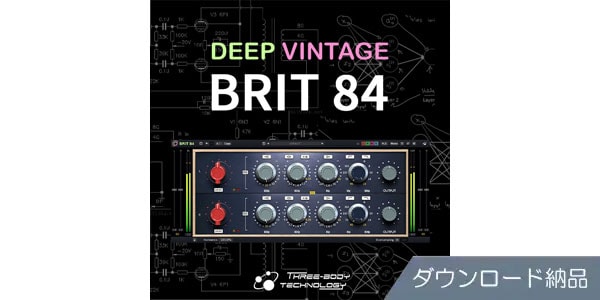


Download this plugin inspired by one of the most legendary preamps in music history.
■Plug-ins
■Preamps
====================================
■Download Delivery
- Approximately 10 minutes after completing your purchase, the activation code will be delivered to your registered email address.
- Activate the code you received on the D2R page below and you will receive product installation information via email. (You can also view the information by clicking the email icon on the D2R page.)
D2R Page
*If you do not have a D2R Page account, please register by clicking ""Register here"" on the D2R Page.
- You can also check your D2R registration activation code by clicking ""Order Details"" in your Sound House My Page or Purchase History.
*It may take a few minutes for the information to be reflected in your purchase history.
- Click ""Support Information"" under ""Order Details"" to display activation information.
- For detailed installation/usage instructions, please contact the manufacturer.
====================================
BRIT 84 is an effect plug-in inspired by the original model of one of the most legendary preamps in music history.
It features a more complex EQ than the BRIT 73, providing unparalleled transparency and sound quality. While similar in appearance, the BRIT 84's EQ features more frequency bands, a unique ""High Q"" mode, and an additional low-pass filter, allowing for more precise EQ control. However, the BRIT 84 is not simply a more advanced version of the BRIT 73; the two have completely different sounds.
BRIT 84 offers a wide range of sonic expression, from subtle coloration to more intense saturation. When used for coloration, it imparts a warm, pleasant melody to the audio signal. When used for saturation, it provides a powerful yet controlled low-frequency enhancement for a rhythmic heft. BRIT 84's rich low frequencies add a deep harmonic quality with substantial weight and presence to bass-heavy elements without muddying the mix. Using it on kick drums is sure to produce a stunning tone.
Deep Vintage: AI Hardware Simulation Plug-in Series
The Deep Vintage series is a collection of plug-ins that harness the power of AI to simulate authentic hardware. These machines are capable of withstanding the Turing test of the human ear, faithfully capturing the true ""soul"" of vintage equipment.
Three-Body Tech's proprietary APNN (Audio Processing Neural Network) machine learning technology, specialized for simulating analog effect processors, ensures a listening experience that most closely resembles legendary hardware models while maintaining fully real-time processing.
APNN (Audio Processing Neural Network) 2.0
Three-Body Tech has experimented with numerous emulation techniques, including physical modeling and convolution. Regardless of the technology used, THREE-BODY TECH's ultimate goal remains consistent: to reproduce the sound of real-world devices as faithfully as possible.
Trained by THREE-BODY TECH's proprietary APNN (Audio Processing Neural Network) 2.0, Deep Vintage delivers a listening experience indistinguishable from the original hardware.
APNN is a neural network optimized for audio processing, consisting of a large number of audio processing modules (EQ, compressor, overdrive, etc.). During the training process, the same audio is input to both the APNN 2.0 and the hardware, and APNN 2.0 learns how the hardware alters the input signal in both waveform and spectral dimensions. To capture the essence of the modeled hardware, it automatically adjusts its structure and parameters until the difference between the hardware and APNN 2.0 outputs is small. In other words, a fully trained APNN 2.0 instance is able to capture both the dynamic and tonal characteristics of the source hardware.
In the end, the APNN achieves phase cancellation with an error of approximately -40dB to -75dB (depending on the hardware model). This exceptional level of error control, even exceeding the variability between different manufacturing lots of the same hardware model, allows us to confidently state that the APNN can ""fool"" the human ear.
After the APNN 2.0 instance completed training, THREE-BODY TECH conducted rigorous human testing and continued tuning until all APNN 2.0 instances passed the ABX test. Nothing in your DAW is as close to real hardware as a plugin with APNN 2.0.
■Features
Drive
Tweaks the drive effect of the current profile.
Presence
Adjusts the harmonic distortion and frequency response of the sound.
Deep
Boosts the low frequencies while affecting the distortion characteristics.
Link Mode Switch
Enables or disables link mode between the two channels, where adjusting parameters on one channel affects the other.
Other Features
- Switchable Noise Simulation
Real hardware is inherently noisy. In fact, some vintage gear can produce extremely high levels of noise. When APNN trains from a hardware model, the training process cannot instruct the network to distinguish between sound and noise, so it captures all sound, including noise. Fortunately, APNN is not a complete black box, and you can control whether or not it generates noise after training. Each DEEP VINTAGE product also allows you to disable/enable noise simulation according to your preferences. * Green AD AI does not have a 'Noise' button, because the noise level of the hardware models is low, making it unnecessary to disable it.
-Harmonics
Generates a certain amount of harmonics based on the modeled hardware. The Drive knob controls saturation by adjusting the input gain, while Harmonics directly edits the network model, forcing the amount of generated harmonics to be reduced. At 100% (default), the harmonic characteristics are closer to the hardware model, and lowering the value reduces the amount of harmonics proportionally (however, due to the nature of the network structure, harmonics cannot be completely bypassed). This allows the plugin to operate in a cleaner state, mostly preserving only changes in frequency response and dynamics.
-Oversampling
While Deep Vintage leverages the power of AI to approximate the hardware models that inspired it, digital audio cannot escape the ""curse"" of aliasing. Enabling 2x, 4x, 8x, and 16x oversampling significantly reduces aliasing.
-Undo/Redo
-A/B Switching
-L/R/M/S Channel Monitoring
Solo and monitor any of the left, right, middle, or side channels.
-Input/Output Level Meters
-Mono Mode
-LR/MS Processing
-Phase Inversion
-GUI Rescaling
Latency
Approximately 0.6 ms at 26 sample points and 44100 Hz
■System Requirements
For the latest system requirements, please refer to the manufacturer's product page.
■Preamps
====================================
■Download Delivery
- Approximately 10 minutes after completing your purchase, the activation code will be delivered to your registered email address.
- Activate the code you received on the D2R page below and you will receive product installation information via email. (You can also view the information by clicking the email icon on the D2R page.)
D2R Page
*If you do not have a D2R Page account, please register by clicking ""Register here"" on the D2R Page.
- You can also check your D2R registration activation code by clicking ""Order Details"" in your Sound House My Page or Purchase History.
*It may take a few minutes for the information to be reflected in your purchase history.
- Click ""Support Information"" under ""Order Details"" to display activation information.
- For detailed installation/usage instructions, please contact the manufacturer.
====================================
BRIT 84 is an effect plug-in inspired by the original model of one of the most legendary preamps in music history.
It features a more complex EQ than the BRIT 73, providing unparalleled transparency and sound quality. While similar in appearance, the BRIT 84's EQ features more frequency bands, a unique ""High Q"" mode, and an additional low-pass filter, allowing for more precise EQ control. However, the BRIT 84 is not simply a more advanced version of the BRIT 73; the two have completely different sounds.
BRIT 84 offers a wide range of sonic expression, from subtle coloration to more intense saturation. When used for coloration, it imparts a warm, pleasant melody to the audio signal. When used for saturation, it provides a powerful yet controlled low-frequency enhancement for a rhythmic heft. BRIT 84's rich low frequencies add a deep harmonic quality with substantial weight and presence to bass-heavy elements without muddying the mix. Using it on kick drums is sure to produce a stunning tone.
Deep Vintage: AI Hardware Simulation Plug-in Series
The Deep Vintage series is a collection of plug-ins that harness the power of AI to simulate authentic hardware. These machines are capable of withstanding the Turing test of the human ear, faithfully capturing the true ""soul"" of vintage equipment.
Three-Body Tech's proprietary APNN (Audio Processing Neural Network) machine learning technology, specialized for simulating analog effect processors, ensures a listening experience that most closely resembles legendary hardware models while maintaining fully real-time processing.
APNN (Audio Processing Neural Network) 2.0
Three-Body Tech has experimented with numerous emulation techniques, including physical modeling and convolution. Regardless of the technology used, THREE-BODY TECH's ultimate goal remains consistent: to reproduce the sound of real-world devices as faithfully as possible.
Trained by THREE-BODY TECH's proprietary APNN (Audio Processing Neural Network) 2.0, Deep Vintage delivers a listening experience indistinguishable from the original hardware.
APNN is a neural network optimized for audio processing, consisting of a large number of audio processing modules (EQ, compressor, overdrive, etc.). During the training process, the same audio is input to both the APNN 2.0 and the hardware, and APNN 2.0 learns how the hardware alters the input signal in both waveform and spectral dimensions. To capture the essence of the modeled hardware, it automatically adjusts its structure and parameters until the difference between the hardware and APNN 2.0 outputs is small. In other words, a fully trained APNN 2.0 instance is able to capture both the dynamic and tonal characteristics of the source hardware.
In the end, the APNN achieves phase cancellation with an error of approximately -40dB to -75dB (depending on the hardware model). This exceptional level of error control, even exceeding the variability between different manufacturing lots of the same hardware model, allows us to confidently state that the APNN can ""fool"" the human ear.
After the APNN 2.0 instance completed training, THREE-BODY TECH conducted rigorous human testing and continued tuning until all APNN 2.0 instances passed the ABX test. Nothing in your DAW is as close to real hardware as a plugin with APNN 2.0.
■Features
Drive
Tweaks the drive effect of the current profile.
Presence
Adjusts the harmonic distortion and frequency response of the sound.
Deep
Boosts the low frequencies while affecting the distortion characteristics.
Link Mode Switch
Enables or disables link mode between the two channels, where adjusting parameters on one channel affects the other.
Other Features
- Switchable Noise Simulation
Real hardware is inherently noisy. In fact, some vintage gear can produce extremely high levels of noise. When APNN trains from a hardware model, the training process cannot instruct the network to distinguish between sound and noise, so it captures all sound, including noise. Fortunately, APNN is not a complete black box, and you can control whether or not it generates noise after training. Each DEEP VINTAGE product also allows you to disable/enable noise simulation according to your preferences. * Green AD AI does not have a 'Noise' button, because the noise level of the hardware models is low, making it unnecessary to disable it.
-Harmonics
Generates a certain amount of harmonics based on the modeled hardware. The Drive knob controls saturation by adjusting the input gain, while Harmonics directly edits the network model, forcing the amount of generated harmonics to be reduced. At 100% (default), the harmonic characteristics are closer to the hardware model, and lowering the value reduces the amount of harmonics proportionally (however, due to the nature of the network structure, harmonics cannot be completely bypassed). This allows the plugin to operate in a cleaner state, mostly preserving only changes in frequency response and dynamics.
-Oversampling
While Deep Vintage leverages the power of AI to approximate the hardware models that inspired it, digital audio cannot escape the ""curse"" of aliasing. Enabling 2x, 4x, 8x, and 16x oversampling significantly reduces aliasing.
-Undo/Redo
-A/B Switching
-L/R/M/S Channel Monitoring
Solo and monitor any of the left, right, middle, or side channels.
-Input/Output Level Meters
-Mono Mode
-LR/MS Processing
-Phase Inversion
-GUI Rescaling
Latency
Approximately 0.6 ms at 26 sample points and 44100 Hz
■System Requirements
For the latest system requirements, please refer to the manufacturer's product page.
商品レビューProduct Review




不適切な投稿として報告しますか?
理由
ご協力ありがとうございました
投稿を削除しますか?
投稿されたレビューを削除しました。
THREE-BODY TECH
BRIT 84 download delivery
Item ID:381578
10,054 yen(incl. tax)

301Pt(3%)Detail
- 100Pts
通常ポイント
- 201Pts
ポイント3倍キャンペーン
- 301Pts
Total
 Download
 Only the serial number will be sent to your registered email address. Orders cannot be changed or cancelled after they have been placed by the customer.
- In Stock
- In Stock, can be shipped when order is confirmed.
- Low Stock
- Low Stock, may be sold out soon.
- Scheduled date
- Expected to arrive at Sound House on this date.
- TBA
- Expected date of arrival at Sound House to be determined.
- Back Order
- It needs to be orderd from the manufacturer. Please inquire about the estimated date of arrival.
- Mfr. Delivery
- Must be ordered from manufacturer. Please inquire about the estimated date of arrival.
- Download
- Only the serial number will be sent to your registered email address.
- Special Order
- Made to order item or must be ordered from manufacturer. May take several weeks or months.
- No Longer Available
- Product is no longer available due to having been discoutined or other reasons.
Rating


この商品に関連するセレクションRelated Articles

-
 Discount Sale
-
 Outlet
-
 New Arrivals
-
 Podcast (streaming)
-
 Headphones / Earphones
-
 Microphones
-
 Wireless Equipment
-
 Speakers
-
 Power Amps
-
 Mixers
-
 Processors
-
 Portable PA Systems
-
 Recorders
-
 Karaoke
-
 Guitars
-
 Basses
-
 Ukuleles
-
 Drums & Percussion
-
 Pianos / Synthesizers
-
 Wind Instruments
-
 Stringed Instruments
-
 Japanese Instruments
-
 Harmonicas, Other
-
 Software
-
 DJ & VJ
-
 Stands
-
 Cables & Connectors
-
 Racks & Cases
-
 Lighting
-
 Stage & Truss
-
 Video Equipment
-
 PC PERIPHERALS
-
 Power Supplies
-
 Studio Furniture
-
 Household Items, Other
-
 Alcoholic Beverages
Search by Brand
Brand List






- Sound House
- 〒286-0825 14-3 Shinizumi , Narita City, Chiba
- Monday-Friday 10:00-17:00
- Narita Call Center
- TEL. 0476-89-1111
- FAX. 0476-89-2222
- Tokushima Call Center
- TEL. 0885-38-1111
- FAX. 0885-38-1100
- Showroom Hours
- Monday-Friday 10:00-17:00
closed on Saturdays, Sundays and Holidays


© Sound House

すべてのレビューを見る